
Discover the meaning of National Weed Appreciation Day, the ecological benefits of weeds, and why these overlooked plants deserve more appreciation.
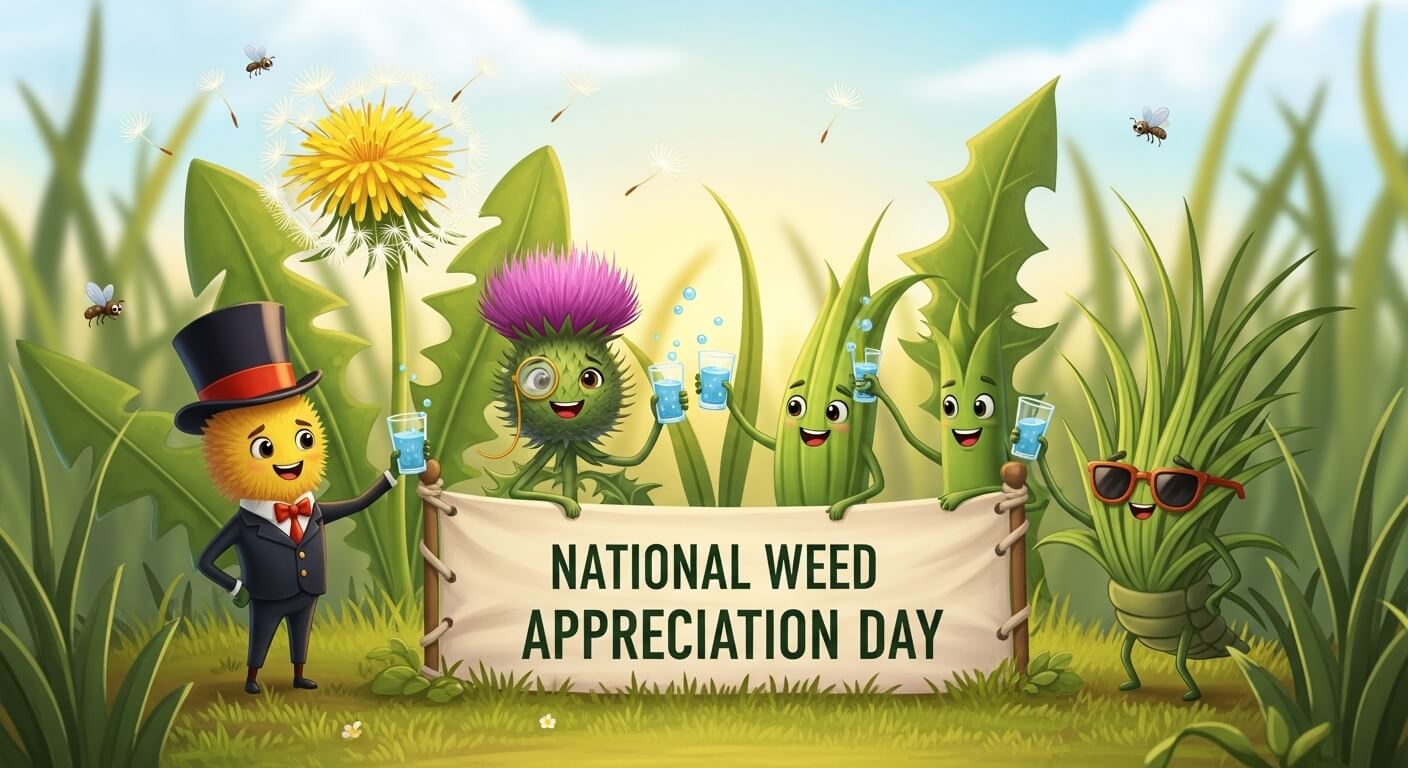
A Story of Overlooked Plants, Quiet Resilience, and the Beauty We Often Miss
There are days that celebrate the obvious—the roses, the forests, the carefully cultivated gardens. And then there is National Weed Appreciation Day, observed every year on March 28, which turns our attention toward something far less celebrated: the plants we routinely pull, cut, and discard without a second thought.
At first, the idea may seem almost ironic. Why would anyone “appreciate” weeds? But as you begin to look closer, the question shifts. Perhaps the real mystery is not why we should appreciate weeds—but why we have learned to overlook them in the first place.
Rethinking the Word “Weed”
The word “weed” carries a certain weight. It suggests something unwanted, intrusive, or out of place. Yet, from a biological perspective, the term is surprisingly vague. A weed is not a specific type of plant—it is simply any plant growing where it is not desired.
This means that the label says more about human preference than about the plant itself. A wildflower in a forest is beautiful. The same flower in a manicured lawn becomes a weed.
This realization lies at the heart of National Weed Appreciation Day: weeds are not inherently bad—they are misunderstood.
They are plants with their own ecological roles, survival strategies, and even hidden benefits.
The Hidden Strength of Weeds
Imagine a crack in the pavement. Dry, harsh, seemingly lifeless. And yet, from that narrow space, a small green plant emerges—fragile in appearance, but incredibly resilient.
Weeds are masters of survival. They grow in poor soil, withstand extreme conditions, and adapt quickly to change. Their seeds travel far, their roots dig deep, and their life cycles are often designed for persistence.
Weeds are not weak—they are among the most adaptable plants in nature.
This resilience is one of the reasons they are so often removed. Their success disrupts human attempts at control. But if we step back, that very resilience becomes something worth admiring.
Ecological Importance: More Than Just “Unwanted Plants”
Beyond their ability to survive, weeds play crucial roles in ecosystems. They prevent soil erosion, improve soil structure, and provide food and shelter for insects and wildlife.
Some weeds are among the first plants to grow in disturbed environments, helping to restore balance. Others attract pollinators, supporting bees, butterflies, and other essential species.
Without weeds, many ecosystems would struggle to recover and sustain themselves.
National Weed Appreciation Day encourages us to see these plants not as intruders, but as contributors—quietly supporting the natural world in ways we often ignore.
Edible and Medicinal Weeds
Perhaps one of the most surprising aspects of weeds is how useful they can be. Many plants we dismiss as nuisances are, in fact, edible or medicinal.
Dandelions, for example, are rich in vitamins and have been used in traditional medicine for centuries. Nettles, though often avoided, are highly nutritious when prepared correctly. Even common weeds like purslane contain beneficial nutrients.
What we call weeds today were once valuable resources in traditional cultures.
This shift in perception—from useful to unwanted—reflects changes in lifestyle and knowledge. National Weed Appreciation Day invites us to reconnect with that lost understanding.
The Human Desire for Control
To fully understand why weeds are often rejected, we must look at human behavior. Gardens, lawns, and landscapes are expressions of control. They reflect our desire to shape nature according to our preferences.
Weeds challenge that control. They appear unexpectedly, grow unpredictably, and resist removal.
In many ways, our relationship with weeds mirrors our relationship with unpredictability itself.
We tend to resist what we cannot easily manage. But this day encourages a different perspective—one that embraces coexistence rather than domination.
A Shift Toward Sustainable Thinking
In recent years, there has been a growing movement toward more sustainable and natural approaches to landscaping. People are beginning to question the heavy use of chemicals and the pursuit of perfectly uniform lawns.
Wild gardens, native plants, and biodiversity are gaining appreciation. In this context, weeds are no longer seen purely as problems, but as part of a larger ecological picture.
National Weed Appreciation Day aligns with this shift, promoting awareness and balance rather than elimination.
It suggests that not every weed needs to be removed—and that sometimes, allowing nature to exist freely can lead to healthier environments.
Finding Beauty in the Overlooked
There is a quiet beauty in weeds that often goes unnoticed. Their shapes, textures, and colors can be just as striking as cultivated plants—if we take the time to observe them.
A dandelion pushing through grass, a cluster of wildflowers along a roadside, a vine climbing an old wall—these are small moments of natural artistry.
Appreciation begins with attention.
National Weed Appreciation Day asks us to slow down and look closer. To see what we usually ignore. And in doing so, to rediscover a sense of wonder in the ordinary.
A Broader Reflection: What We Choose to Value
Beyond plants, this day carries a deeper message. It challenges us to reconsider how we assign value—not just in nature, but in life.
What do we label as unwanted? What do we overlook? And what might we discover if we chose to see things differently?
Sometimes, the most meaningful insights come from what we initially dismiss.
Weeds, in their quiet persistence, remind us that value is often a matter of perspective.
Final Reflection
National Weed Appreciation Day is not about abandoning gardens or letting nature run wild without thought. It is about awareness. It is about understanding that even the smallest, most overlooked elements of our environment have a role to play.
It invites us to pause before pulling a plant from the ground. To ask not just “Why is this here?” but “What purpose might it serve?”
Because in the end, appreciation is not about perfection—it is about recognition.
And sometimes, the most overlooked things are the ones most worth noticing.

