
Discover the history of National Black Forest Cake Day, the origins of Schwarzwälder Kirschtorte, and what makes this iconic chocolate cherry dessert unique.
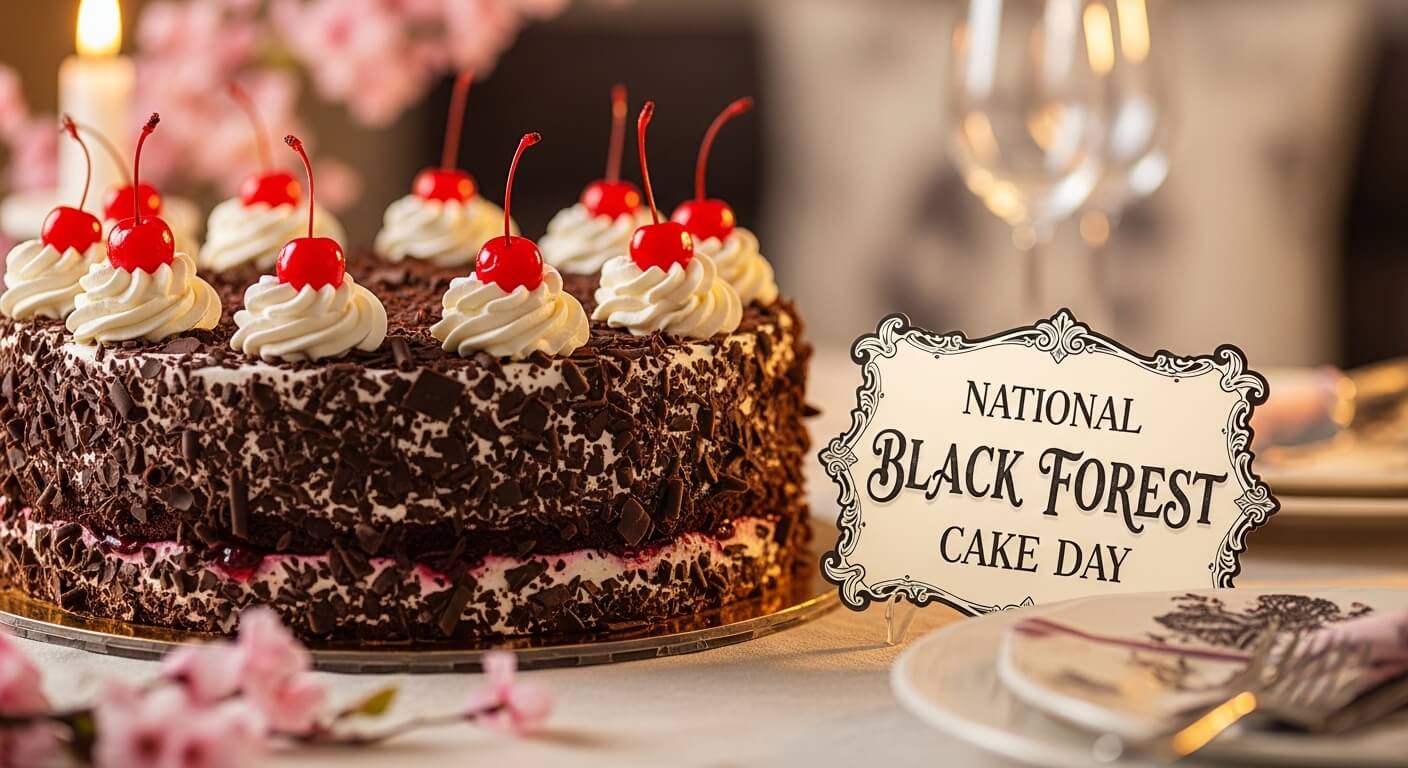
A Journey Through Layers of Chocolate, Cherries, and Timeless Tradition
There are desserts that satisfy a craving… and then there are desserts that tell a story. National Black Forest Cake Day, celebrated every year on March 28, belongs firmly to the second category. It is not just about indulgence—it is about heritage, craftsmanship, and the delicate balance between richness and elegance.
At first glance, a slice of Black Forest cake may seem like a simple combination of chocolate, cream, and cherries. But beneath those layers lies a narrative shaped by geography, culture, and centuries of culinary refinement. And this day invites us not only to taste it—but to understand it.
The Origins: From Germany’s Dark Forest to the World
To truly appreciate Black Forest cake, you must begin in southwestern Germany, in a region known as the Black Forest. This dense, mysterious landscape of evergreen trees and misty hills has long inspired folklore, tradition, and, eventually, one of the world’s most iconic desserts.
The cake’s original name, Schwarzwälder Kirschtorte, translates directly to “Black Forest cherry torte.” Contrary to popular belief, the name does not necessarily come from the forest itself, but from a key ingredient: Kirschwasser, a clear cherry brandy traditionally produced in the region.
It is this ingredient that gives the cake its unmistakable depth. Without it, the dessert loses not just flavor, but identity. Authentic Black Forest cake is defined as much by its Kirsch as by its chocolate layers.
The Anatomy of a Masterpiece
Imagine cutting into a perfectly made Black Forest cake. The knife glides through soft whipped cream, moist chocolate sponge, and pockets of tart cherries. Each layer reveals a contrast—not just in texture, but in emotion.
At its core, the cake is built from chocolate sponge layers soaked lightly in Kirsch. Between them, whipped cream is folded generously, along with cherries that bring a bright, slightly acidic balance. The exterior is often decorated with more cream, chocolate shavings, and whole cherries—an aesthetic that feels both rustic and refined.
What makes it extraordinary is not complexity, but harmony. The sweetness never overwhelms, the bitterness never dominates, and the fruitiness never feels out of place. Every bite is carefully calibrated.
The Role of Kirsch: The Soul of the Cake
There is one element that separates a true Black Forest cake from its imitations: Kirschwasser.
This cherry brandy is not simply an additive—it is the soul of the dessert. It infuses the sponge with aroma, enhances the cherries, and cuts through the richness of the cream. Without it, the cake risks becoming just another chocolate dessert.
In traditional German baking laws, a cake cannot be labeled “Schwarzwälder Kirschtorte” unless it contains Kirsch. This detail reflects how deeply authenticity is respected in its origin culture.
And yet, in many modern adaptations around the world, Kirsch is often omitted—either for accessibility or preference. What remains is a version of the cake, but not its full story.
A Cultural Icon Beyond the Kitchen
Over time, Black Forest cake has transcended its regional roots. It has become a global symbol of European patisserie, appearing in bakeries from Tokyo to New York.
But its cultural resonance goes deeper. The cake is often associated with celebration—birthdays, weddings, and special gatherings. Its layered structure and rich flavors make it a centerpiece, not just a dessert.
In a way, Black Forest cake represents the idea that food can carry identity across borders. Even when adapted, it retains a connection to its origins, reminding us where it came from.
National Black Forest Cake Day: More Than a Sweet Celebration
So why dedicate an entire day to this cake?
National Black Forest Cake Day is not just about eating dessert. It is about honoring craftsmanship, tradition, and the stories embedded in food. It encourages people to explore authentic recipes, support local bakeries, or even attempt to create the cake themselves.
There is something almost meditative about baking it. Layering the sponge, whipping the cream, arranging the cherries—it becomes an act of patience and care.
This day transforms a simple slice into an experience—one that connects taste with history.
Variations and Modern Interpretations
As with any iconic dish, Black Forest cake has evolved. Today, you can find countless variations: alcohol-free versions, vegan adaptations, cupcake forms, and even deconstructed presentations.
Some use dark chocolate ganache instead of traditional sponge. Others replace cherries with different fruits. While these interpretations can be creative and delicious, they also raise an interesting question:
At what point does a variation stop being a Black Forest cake?
The answer often lies in intention. If the essence—the balance of chocolate, cream, cherries, and Kirsch—is preserved, the spirit remains intact. But when those elements disappear, so does the connection.
Tradition is not about rigidity, but about remembering what makes something meaningful.
The Sensory Experience: Why It Endures
Close your eyes and imagine the first bite. The softness of the sponge, the coolness of the cream, the slight tang of cherries, and the faint warmth of Kirsch.
It is not just taste—it is texture, aroma, and memory.
This is why Black Forest cake endures. It engages multiple senses at once, creating an experience that feels both comforting and sophisticated.
Great desserts do more than satisfy hunger—they create moments. And this cake has been doing so for generations.
A Final Reflection: Layers Beyond the Plate
In many ways, Black Forest cake mirrors life itself. It is layered, complex, and balanced between contrasts—sweet and bitter, light and rich, simple and intricate.
National Black Forest Cake Day invites us to slow down and appreciate those layers—not just in the cake, but in the traditions we often take for granted.
Because behind every slice, there is a story. And behind every story, there is a place, a culture, and a history waiting to be remembered.
So on March 28, whether you bake it, buy it, or simply read about it, take a moment to experience it fully.
Not just as a dessert—but as a piece of living tradition.

