
Discover the meaning of National Something on a Stick Day, its origins, global food traditions, and why skewered foods are loved worldwide.
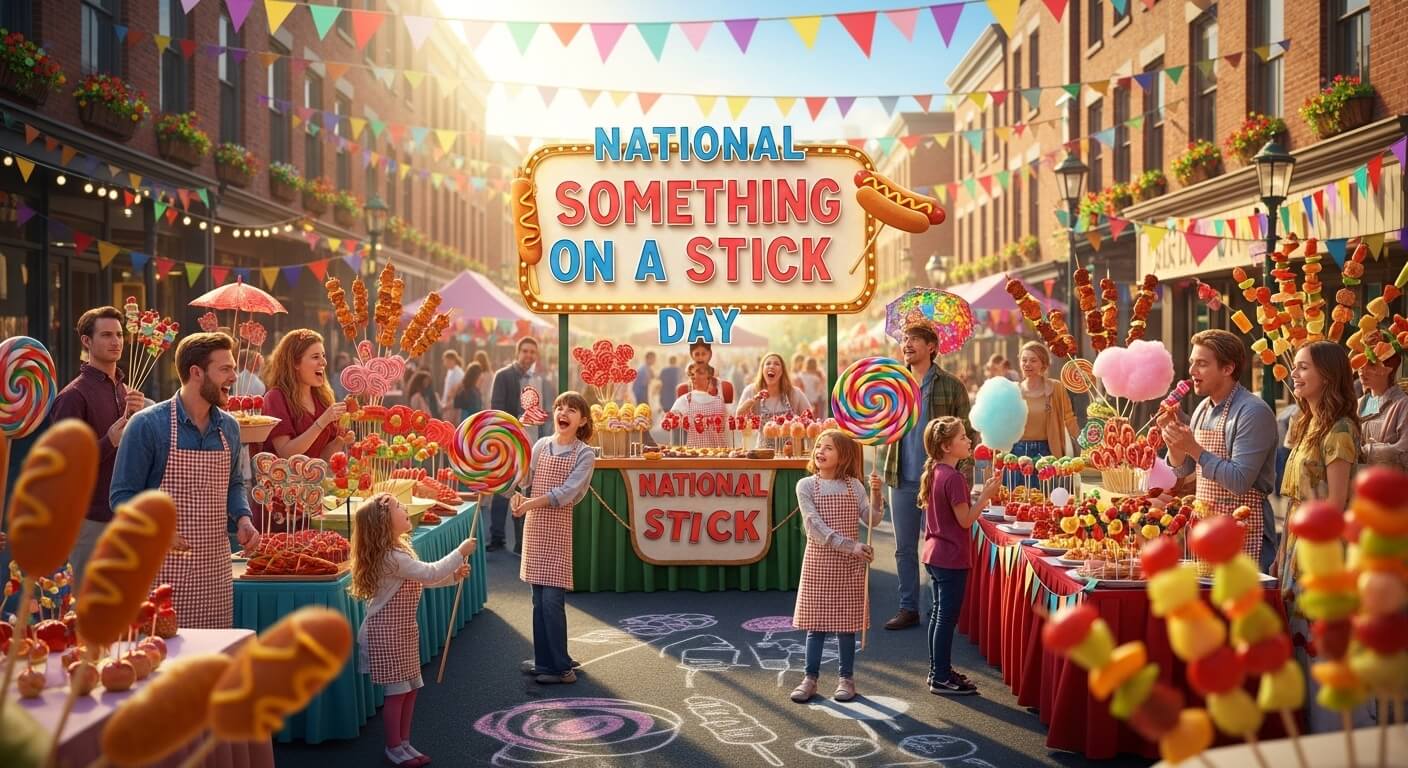
A Playful Celebration of Simplicity, Street Food, and Culinary Creativity
Some holidays are rooted in deep tradition, others in historical milestones—and then there are those that feel delightfully spontaneous. National Something on a Stick Day, celebrated every year on March 28, belongs to that rare category of joyful absurdity. At first glance, it may sound like a quirky, almost humorous observance. But beneath its playful name lies a fascinating story about how food, culture, and human ingenuity intersect in the simplest of forms: putting something on a stick.
Because sometimes, the smallest ideas—like skewering food—carry the biggest impact.
The Curious Origin of “Something on a Stick”
Unlike many food holidays tied to a specific invention or individual, National Something on a Stick Day does not trace back to a single origin story. Its roots are more conceptual, emerging from a universal culinary practice that spans cultures and centuries.
The idea itself is ancient. Long before modern kitchens and utensils, humans discovered that placing food on sticks made cooking easier. Meat could be held over open flames, rotated evenly, and consumed without direct contact. It was practical, efficient, and—perhaps unknowingly—innovative.
Over time, this method evolved into a global culinary phenomenon. From street vendors to fine dining chefs, the simple act of putting food on a stick became a symbol of convenience, portability, and creativity.
National Something on a Stick Day celebrates that evolution—not as a specific dish, but as a concept that continues to inspire.
A Global Language of Food on a Stick
Travel across the world, and you will encounter countless variations of “something on a stick.” Each culture interprets it differently, yet the underlying idea remains the same.
In Japan, skewered delicacies like yakitori bring together grilled chicken and subtle seasoning. In the Middle East, kebabs transform meat into aromatic, flame-kissed perfection. Across Europe, sausages and roasted treats find their place on wooden sticks during festivals. And in the United States, fairs and carnivals have elevated the concept into spectacle—deep-fried creations, corn dogs, and desserts, all served on sticks.
What connects these diverse traditions is not just technique, but philosophy. Food on a stick removes barriers—it is accessible, informal, and shared across social boundaries.
It does not require a table, elaborate tools, or ceremony. It invites spontaneity.
Why a Stick Changes Everything
At first, it may seem trivial. Why does adding a stick matter?
But consider this: a stick transforms how we interact with food. It changes the experience from static to dynamic. It allows movement, portability, and even playfulness.
Think of walking through a festival, holding a skewer of grilled food, the aroma rising with each step. There is no need to sit, no need to pause completely. You are part of the environment, not separated from it.
The stick turns food into an experience, not just a meal.
It also introduces a tactile element—holding, turning, dipping. Eating becomes interactive. And in that interaction, there is joy.
Street Food Culture and the Rise of Convenience
Much of the popularity of food on a stick is tied to the rise of street food culture. In bustling markets and crowded cities, efficiency is essential. Vendors need to serve quickly, and customers need to eat on the move.
A stick solves both problems.
It allows for quick preparation, easy handling, and minimal waste. It also creates visual appeal—rows of skewers sizzling over open flames, each one promising flavor and warmth.
Street food is not just about sustenance—it is about atmosphere, energy, and connection. And food on a stick fits perfectly into that rhythm.
National Something on a Stick Day pays tribute to this vibrant culinary world, where simplicity meets innovation.
From Savory to Sweet: Endless Possibilities
One of the most fascinating aspects of this concept is its versatility. Almost anything can be placed on a stick—meat, vegetables, fruits, even desserts.
Savory options often dominate, but sweet variations have carved out their own space. Caramel apples, chocolate-dipped bananas, cake pops—each one transforms dessert into something portable and visually engaging.
This adaptability is what keeps the idea fresh. There are no strict rules, no limitations. Creativity becomes the main ingredient.
And perhaps that is why this holiday feels so open-ended. It is not about a specific recipe—it is about imagination.
The Psychology of Fun Food
There is also a psychological dimension to food on a stick. It feels different—lighter, more casual, even nostalgic.
Many people associate it with childhood memories: fairs, festivals, summer evenings. There is a sense of playfulness that traditional dining often lacks.
Food on a stick breaks formality and invites enjoyment without structure. It allows people to reconnect with a simpler way of eating—one that prioritizes experience over etiquette.
This emotional connection is a key reason why the concept has endured across generations.
Celebrating National Something on a Stick Day
So how do people celebrate this unusual holiday?
Some visit street food markets or festivals, exploring different skewered dishes. Others experiment in their own kitchens, creating unique combinations—mixing flavors, textures, and cuisines.
It can be as simple as preparing fruit skewers at home, or as elaborate as hosting a themed gathering where every dish must be served on a stick.
The beauty of this day lies in its flexibility. There is no right or wrong way to celebrate—only the invitation to participate.
And in that participation, there is a shared sense of creativity and curiosity.
A Final Reflection: Simplicity as Innovation
In a world that often equates complexity with value, National Something on a Stick Day offers a refreshing perspective. It reminds us that innovation does not always require sophistication.
Sometimes, it begins with something as simple as a stick.
The most enduring ideas are often the simplest ones—adaptable, accessible, and universally understood. Food on a stick embodies all of these qualities, making it more than just a culinary technique.
It is a reminder that creativity thrives within constraints, and that joy can be found in the most unexpected places.
So on March 28, take a moment to embrace the playful side of food. Try something new. Put it on a stick. And experience how a small change can transform the ordinary into something memorable.

