
İngilizce zıt anlamlı kelimeleri eşleştirme egzersizleri, zıt anlamlı kelimelerin cümle içinde kullanımı ile ilgili örnekler, alıştırmalar.
İngilizce öğrenirken kelime dağarcığınızı zenginleştirmenin en etkili yollarından biri, kelimelerin yalnızca anlamlarını değil aynı zamanda zıt anlamlılarını (antonyms) da öğrenmektir. Zıt anlamlı kelimeler, dili daha yaratıcı kullanmanızı sağlar, konuşma ve yazma becerilerinizi geliştirir ve aynı zamanda cümlelerin anlam derinliğini kavramanıza yardımcı olur.
Bu yazıda, İngilizce zıt anlamlı kelimeleri eşleştirme çalışmaları ve boşluk doldurma egzersizleri ile pekiştireceğiz. Ayrıca kelimeleri cümle içinde nasıl kullanabileceğinizi görecek, günlük hayatta karşılaşabileceğiniz örneklerle bilginizi kalıcı hale getireceksiniz.
Amaç: İngilizce zıt anlamlı kelimeler ile kelime hazinesini geliştirmek
Aktivite: Kelimelerin zıt anlamlılarını bulmak ve cümle içinde kullanmak
Seviye: Orta – Orta-üstü (Intermediate – Upper Intermediate)
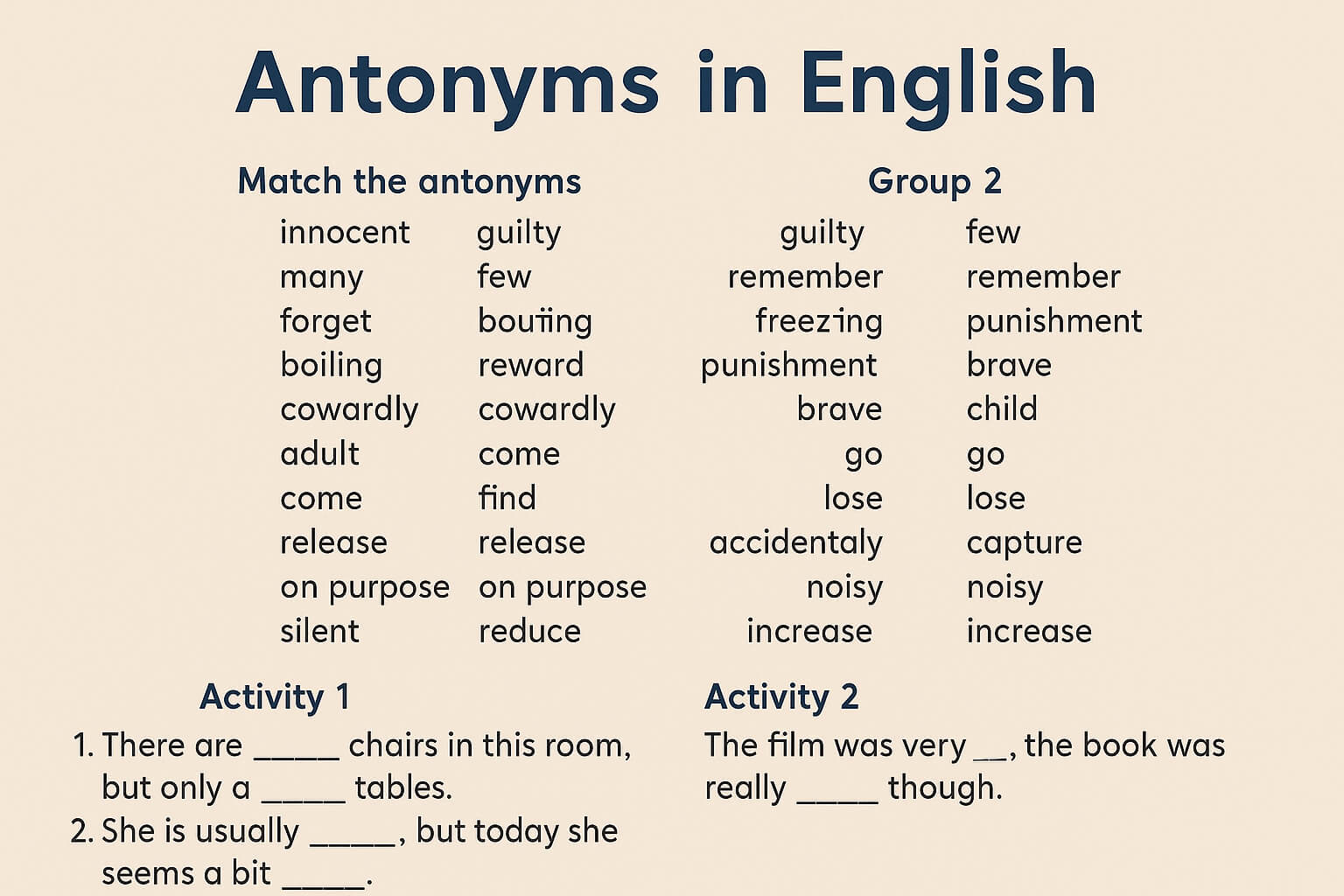
Etkinlik 1: Zıt Anlamlı Kelimeleri Eşleştirin
Aşağıda iki ayrı grup verilmiştir. Göreviniz, Group 1’deki kelimeleri Group 2’deki doğru zıt anlamlıları ile eşleştirmek. Bu çalışmayı yaptıktan sonra, öğrendiğiniz kelimeleri Etkinlik 2’de cümle içinde uygulama fırsatı bulacaksınız.
Group 1
innocent
many
forget
boiling
reward
cowardly
adult
come
find
release
on purpose
silent
reduce
enemy
interesting
depart
ignore
none
past
expensive
apart
false
attack
hate
succeed
passive
say
narrow
minimum
shallow
Group 2
deep
maximum
wide
ask
active
fail
love
defend
true
together
cheap
future
all
help
return
boring
friend
increase
noisy
accidentally
capture
lose
go
child
brave
punishment
freezing
remember
few
guilty
Etkinlik 2: Boşlukları Doğru Zıt Anlamlılarla Doldurun
Şimdi öğrendiğiniz kelimeleri cümle içinde pekiştirelim. Aşağıdaki cümlelerde boş bırakılan yerlere uygun zıt anlamlı kelimeleri getiriniz.
-
How _____ friends do you have in New York? / I have a _____ friends in Chicago.
-
The man pleaded _____, but the jury found the man _____.
-
The freeway is very _____, but country roads are often very _____.
-
Did you know that there is a _____ speed limit as well as a _____ speed limit?
-
Make sure to tell yourself that you will _____. Otherwise, you might _____.
-
Parents disagree about what type of _____ they should give their children if they misbehave. However, most agree that a _____ is a good idea for a job well done.
-
Sometimes a _____ will say they want to be an _____, but we all know it’s the other way around.
-
It’s surprising how many people say “I _____ you!” just a few weeks after saying “I _____ you!”
-
Most people agree that one of the government’s main jobs is to _____ its citizens from _____.
-
Sometimes I say “It depends” if I can’t say something is _____ or _____.
-
You’ll find that many couples sometimes need some time _____ after being _____ for a long time.
-
Lunch wasn’t _____. In fact, it was rather _____.
-
What does your _____ hold for you? Will it be the same as in the _____?
-
Not _____ the students agreed with him. In fact, _____ agreed with him!
-
It’s important to learn the difference between the _____ and _____ voice in English.
-
If you don’t want to _____, please don’t _____ me!
-
Go over there to the _____ side of the river. It’s too _____ where you are standing.
-
If you _____ me nicely, I will _____ something to make you happy.
-
I’ll _____ on May 5th. I _____ on April 14th.
-
How many professors do you find _____? Which ones do you find _____?
-
Sometimes a _____ can become an _____. It’s a sad fact of life.
-
Many people feel we should _____ the amount of money we spend on weapons. Others feel we should _____ spending.
-
I love walking outside in nature where it’s _____ compared to the _____ city.
-
She met her future husband _____. Of course, he says it was _____.
-
The police want to _____ the thief. If they don’t find the right one, they’ll have to _____ them.
-
Did you _____ your keys again? Would you like me to help you _____ them?
-
You can _____ and _____ as you please.
-
She’s a _____ warrior. He, on the other hand, is very _____.
-
You shouldn’t stick your hands in _____ or _____ water.
-
Do you think you will _____ everything? Is it possible you might _____?
Etkinlik 1’in Cevapları
-
deep ↔ shallow
-
maximum ↔ minimum
-
wide ↔ narrow
-
ask ↔ say
-
active ↔ passive
-
fail ↔ succeed
-
love ↔ hate
-
defend ↔ attack
-
true ↔ false
-
together ↔ apart
-
cheap ↔ expensive
-
future ↔ past
-
all ↔ none
-
help ↔ ignore
-
return ↔ depart
-
boring ↔ interesting
-
friend ↔ enemy
-
increase ↔ reduce
-
noisy ↔ silent
-
accidentally ↔ on purpose
-
capture ↔ release
-
lose ↔ find
-
go ↔ come
-
child ↔ adult
-
brave ↔ cowardly
-
punishment ↔ reward
-
freezing ↔ boiling
-
remember ↔ forget
-
few ↔ many
-
guilty ↔ innocent
Etkinlik 2’nin Cevapları
-
few – many
-
guilty – innocent
-
wide – narrow
-
maximum – minimum
-
fail – succeed
-
punishment – reward
-
child – adult
-
love – hate
-
defend – attack
-
true – false
-
together – apart
-
cheap – expensive
-
future – past
-
all – none
-
active – passive
-
help – ignore
-
deep – shallow
-
ask – say
-
return – depart
-
boring – interesting
-
friend – enemy
-
increase – reduce
-
noisy – silent
-
accidentally – on purpose
-
capture – release
-
lose – find
-
go – come
-
brave – cowardly
-
freezing – boiling
-
remember – forget
Ekstra Örnek Cümleler ile Pekiştirme
-
Active vs. Passive → She is an active student in class, but her brother is very passive.
-
Love vs. Hate → Some people love spicy food, while others absolutely hate it.
-
Future vs. Past → Stop living in the past and focus on your future.
-
True vs. False → The statement was true, but his explanation was false.
-
Few vs. Many → Only a few people attended the meeting, but many promised to come next time.
Bu tarz cümlelerle egzersizi genişleterek, zıt anlamlı kelimeleri sadece ezberlemek değil, aynı zamanda doğru bağlamda kullanmak da öğrenilmiş olur.

