
Osmanlı padişahlarından Kanuni Sultan Süleyman’ın döneminin İngilizce olarak açıklanması, anlatımı, tanıtımı. Kanuni Sultan Süleyman ingilizce hayatı.
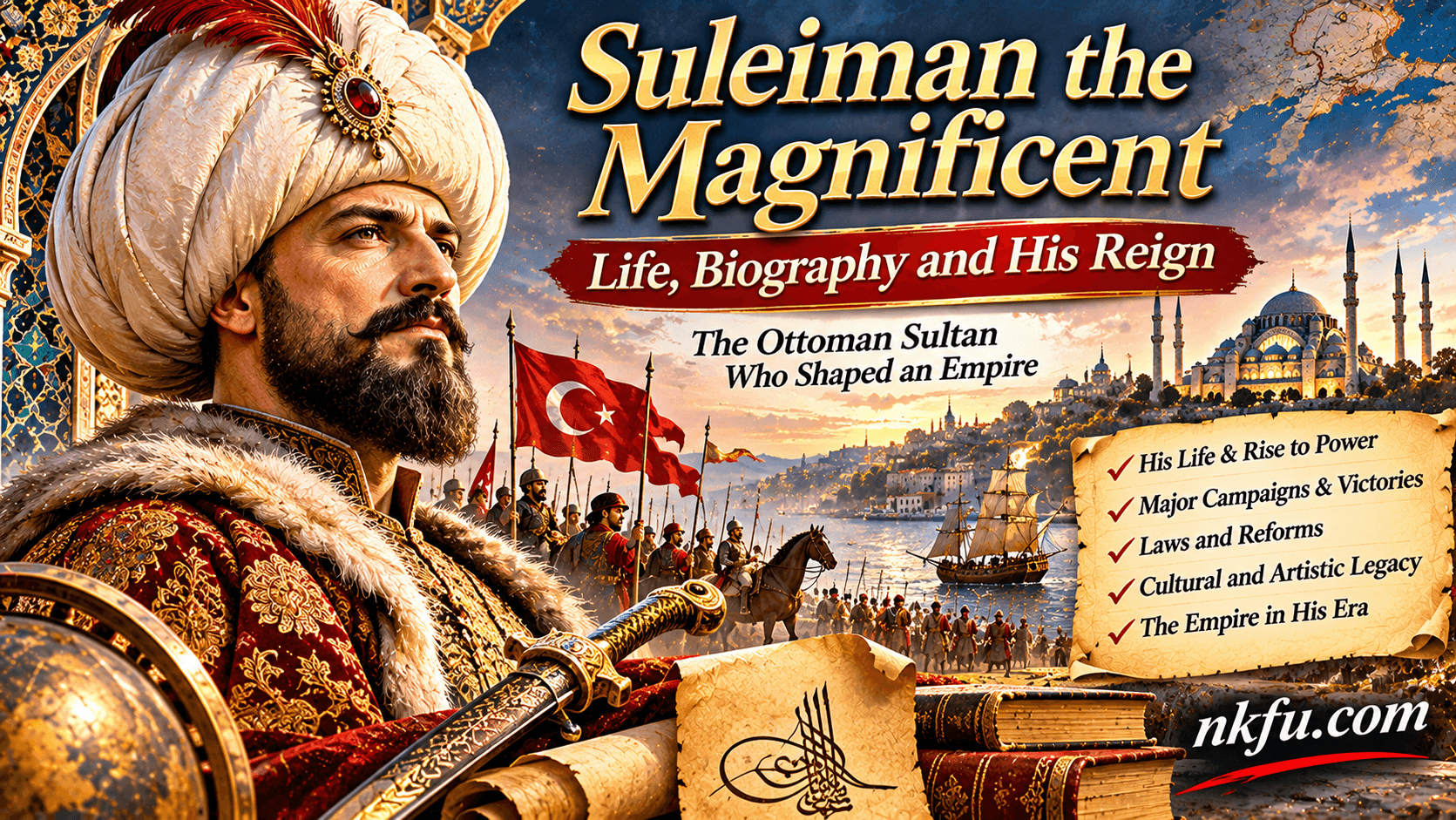
Suleiman the Magnificent was one of the most powerful and influential rulers in world history. He was the tenth Sultan of the Ottoman Empire and ruled from 1520 to 1566. During his 46-year reign, the Ottoman Empire reached the height of its political, military, economic and cultural power.
Known as Suleiman the Magnificent in the Western world and Kanuni Sultan Süleyman (Suleiman the Lawgiver) in Turkish history, he expanded the empire across three continents, strengthened its legal system, supported architecture and literature, and transformed Istanbul into one of the greatest cultural centers of the 16th century.
His military campaigns, diplomatic achievements and administrative reforms made him one of the most remarkable monarchs of the Renaissance era.
1. Early Life and Childhood
Suleiman was born on November 6, 1494, in Trabzon, a city on the Black Sea coast of the Ottoman Empire. He was the son of Sultan Selim I, who later became known as Selim the Grim.
From an early age, Suleiman received an extensive education in history, literature, mathematics, religion, military strategy and administration. He also studied Arabic and Persian and developed a strong interest in poetry and the arts.
As a young prince, he was appointed governor of several Ottoman provinces. These responsibilities allowed him to gain valuable experience in government and military administration.
When his father died in 1520, Suleiman became the tenth Ottoman Sultan at the age of 25.
2. Becoming the Sultan of the Ottoman Empire
Suleiman ascended the Ottoman throne in September 1520. At the beginning of his reign, the empire was already a major international power, but he had ambitious plans to expand its influence.
Unlike many rulers who focused only on military conquest, Suleiman also believed that a powerful empire needed an effective legal system, a stable administration and a flourishing cultural life.
His reign became a period of extraordinary expansion and transformation.
The Ottoman Empire extended its influence across southeastern Europe, the Middle East and North Africa. Its armies challenged major European powers, while its navy became one of the strongest maritime forces in the Mediterranean.
3. Major Military Campaigns and Victories
Suleiman the Magnificent personally led many military campaigns. His victories significantly expanded the borders and international influence of the Ottoman Empire.
The Conquest of Belgrade (1521)
Belgrade was one of the most important strategic fortresses in southeastern Europe. Its location made it a key gateway between the Ottoman territories in the Balkans and Central Europe.
In 1521, Suleiman launched a military campaign against the city. After a difficult siege, Ottoman forces captured Belgrade.
This victory strengthened Ottoman control in the Balkans and prepared the way for further expansion into Hungary.
The Conquest of Rhodes (1522)
Rhodes was controlled by the Knights Hospitaller, a powerful military religious order that threatened Ottoman maritime routes.
Suleiman organized a major expedition against the island in 1522. After months of fighting, the defenders surrendered.
The conquest of Rhodes strengthened Ottoman control over the eastern Mediterranean and secured important maritime routes.
The Battle of Mohács (1526)
One of the most important victories of Suleiman’s reign was the Battle of Mohács, fought on August 29, 1526.
The Ottoman army confronted the forces of the Kingdom of Hungary under King Louis II.
The battle ended in a decisive Ottoman victory. King Louis II died during his retreat, and the Hungarian Kingdom entered a period of political division and instability.
The victory at Mohács greatly increased Ottoman influence in Central Europe.
The Siege of Vienna (1529)
After the Ottoman victory in Hungary, Suleiman advanced toward Vienna, the capital of the Habsburg territories.
In 1529, Ottoman forces laid siege to the city. However, difficult weather conditions, logistical problems and strong defensive positions prevented the Ottomans from capturing Vienna.
Although the siege was unsuccessful, it demonstrated the extraordinary military reach of the Ottoman Empire.
The Baghdad Campaign (1534)
Suleiman also directed his attention toward the eastern territories.
In 1534, Ottoman forces captured Baghdad from the Safavid Empire. This victory strengthened Ottoman influence in Mesopotamia and secured an important strategic position in the region.
Baghdad became an important center of Ottoman administration, trade and culture.
4. Suleiman and the Ottoman Navy
Suleiman understood that controlling the Mediterranean was essential for maintaining the empire’s international power.
During his reign, the Ottoman navy became one of the most formidable maritime forces in the world.
One of the most important naval commanders of this period was Barbarossa Hayreddin Pasha, who served as Grand Admiral of the Ottoman fleet.
In 1538, the Ottoman navy achieved a historic victory at the Battle of Preveza against a Christian coalition fleet commanded by Andrea Doria.
This victory strengthened Ottoman naval supremacy in the Mediterranean and became one of the greatest achievements of Ottoman maritime history.
5. Suleiman as the Lawgiver (Kanuni)
Suleiman is remembered in Turkish history not only as a successful military commander but also as a ruler who reformed the legal and administrative systems of the empire.
The title Kanuni, meaning “the Lawgiver,” reflects his efforts to organize and improve Ottoman law.
He worked to establish a more systematic relationship between Islamic law and imperial regulations.
His legal reforms covered several important areas:
- Taxation and land administration.
- Rights and responsibilities of different social groups.
- Criminal punishments and legal procedures.
- State administration and public order.
- Economic regulations and commercial activities.
These reforms helped strengthen the central administration and provided a more consistent legal framework throughout the empire.
His legal legacy remained influential long after his death.
6. Suleiman’s Wife: Hürrem Sultan
Hürrem Sultan was one of the most influential women in Ottoman history and the wife of Suleiman the Magnificent.
Originally known in European sources as Roxelana, she became an important figure in the Ottoman royal court.
Unlike earlier Ottoman traditions, Suleiman formed a formal marital relationship with Hürrem, and she played a significant role in palace politics and charitable activities.
She supported the construction of mosques, schools, hospitals and public facilities.
Their relationship also became one of the most discussed royal partnerships of the 16th century.
Among their children was Selim II, who succeeded Suleiman as Sultan.
7. Culture, Architecture and the Arts During His Reign
Suleiman’s reign is often described as the golden age of classical Ottoman architecture, literature and decorative arts.
One of the greatest architects of this period was Mimar Sinan, who designed some of the most remarkable buildings in Ottoman history.
His masterpieces included:
- Süleymaniye Mosque in Istanbul.
- Selimiye Mosque in Edirne.
- Şehzade Mosque in Istanbul.
- Numerous bridges, schools, hospitals and public buildings.
The Süleymaniye Mosque, commissioned by Suleiman, became one of the most impressive architectural symbols of the Ottoman capital.
Literature and poetry also flourished during this period. Suleiman himself wrote poetry under the pen name Muhibbi.
His poems explored love, friendship, faith, mortality and the responsibilities of leadership.
The artistic achievements of this era reflected the wealth, confidence and cultural sophistication of the Ottoman Empire.
8. The Final Campaign and Death of Suleiman
Suleiman remained active as a military leader even in his later years.
In 1566, at the age of 71, he personally led an Ottoman campaign against the Habsburg-controlled fortress of Szigetvár in Hungary.
During the siege, his health deteriorated, and he died on September 7, 1566, shortly before the fortress was captured by Ottoman forces.
His death was initially kept secret from the army to prevent confusion and a loss of morale.
His body was eventually returned to Istanbul, where he was buried near the Süleymaniye Mosque.
His son Selim II succeeded him as Sultan.
9. Why Is Suleiman the Magnificent Important in World History?
Suleiman the Magnificent was much more than a military conqueror. His reign transformed the Ottoman Empire into a major political, military and cultural power.
His importance can be summarized through several achievements:
- He expanded the Ottoman Empire across Europe, Asia and Africa.
- He strengthened the Ottoman navy and Mediterranean influence.
- He introduced important legal and administrative reforms.
- He supported architecture, literature and the arts.
- He strengthened diplomatic relations with European powers.
- He established a legacy that influenced Ottoman government for generations.
Conclusion
Suleiman the Magnificent remains one of the most celebrated rulers in Ottoman and world history. His 46-year reign was marked by military victories, political expansion, legal reforms and remarkable cultural achievements.
Known as the Magnificent in the West and the Lawgiver in the Ottoman tradition, he left behind an empire at the height of its power.
His legacy can still be seen in the magnificent mosques, historical monuments, legal traditions and literary works that survived for centuries.
Suleiman’s life represents one of the most extraordinary chapters in the history of the Ottoman Empire.

